
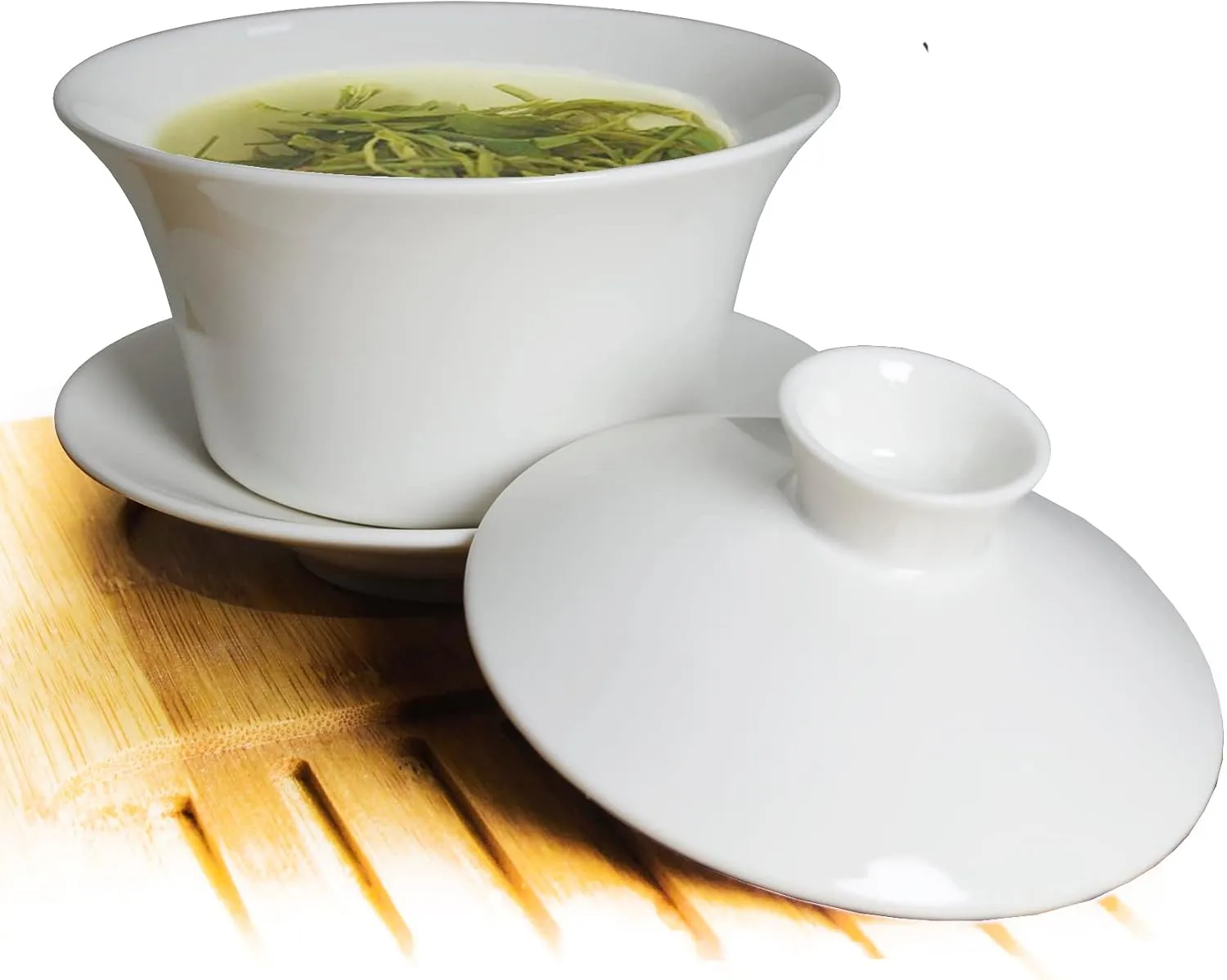
Is a 300 ml Gaiwan Too Big? A Practical Guide to Choosing and Using a Lidded Tea Bowl
Affiliate disclosure: Silk Rhyme may earn a commission if you buy a product through links on this page, at no extra cost to you.
A 300 ml gaiwan looks generous on a product page and oversized on a tea tray. That tension is useful, not a defect: the lidded bowl is a flexible brewing tool, and capacity changes how it behaves. This guide explains what a gaiwan is, why many gongfu bowls are much smaller, and how to judge the Liang baobao 300 ml white porcelain gaiwan before you buy. We have not used this specific vessel in person. Specifications below come from the Amazon listing we checked at 10:51 a.m. on 22 November 2026 (Asia/Shanghai); cultural and typical-size notes come from published references cited at the end.
What a gaiwan is for
A gaiwan (盖碗, “lidded bowl”) is a Chinese vessel without a handle, used to steep loose tea and either drink from the bowl or pour the liquor into another container. It is usually three pieces: bowl, lid, and saucer. The form became established during the Ming dynasty. The open, glazed bowl lets you watch the leaves and does not add an unglazed-clay taste; the lid holds heat, holds back leaves when you drink or decant, and can be set aside to cool a steep. These points are summarized from the Wikipedia article “Gaiwan”, which in turn cites tea references such as Rubin and Gold, and Gascoyne et al.
You can use a gaiwan for green, white, oolong, and other loose teas. Some writers prefer it for more delicate teas and note that a wide lid can let heat escape faster than a small teapot — a reason it is not automatically the best vessel for every black tea. Treat that as guidance from published tea writing, not as a rule we tested.
Typical size, and why 300 ml is large
Wikipedia’s article, citing Max Falkowitz in Serious Eats, describes typical gaiwans as small, often around 100–150 ml, with some as low as 80 ml. That range matches the bowls many people use for gongfu-style brewing: a relatively high dose of leaf in a modest volume of water, several short steeps, and a complete pour each time.
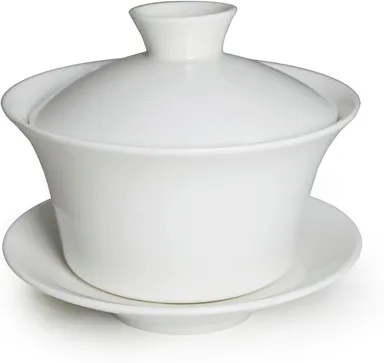
The Liang baobao listing we checked is the 300 ml (10 oz) white variant, ASIN B0BDZ462FM. The same page also states a brim-full capacity of 350 ml, with a bowl about 11.5 cm in diameter and 10.5 cm in total height. The box contains a lid, a bowl, and a saucer — not extra tasting cups. At roughly twice a common gongfu volume, this bowl will give you more liquor per steep, or enough to share, but it will also dilute a “small-bowl” leaf dose unless you add leaf or accept a lighter cup.
Working volume versus filling to the brim
Sellers often print a generous capacity that assumes the bowl is filled close to the rim. In use, you usually leave space so the liquor does not surge under the lid when you pour, and so you can hold the rim. Treat 300 ml as the labelled size and 350 ml as a brim measurement from the listing, not as the volume you will brew every time. If you brew gongfu-style, start with less water than the rim allows, note how much you actually poured, and adjust the leaf until the strength suits you.
When a large gaiwan helps — and when it gets in the way
- Helpful: pouring for two or three people from one steep; brewing teas you prefer in a larger, gentler infusion; using the gaiwan as a simple mug-and-lid for everyday leaf tea.
- Awkward: tightly controlled short steeps with a small, precise leaf-to-water ratio; one-person sessions where a 120 ml bowl would finish faster and stay easier to hold; expecting a full table setting of cups, which this listing does not include.
- Heat and grip: a wider, fuller bowl is heavier and can be hotter to hold. Wikipedia’s usage note is practical here — the usual method is to support the saucer and bowl together and manage the lid with the other hand, and the liquid is hot, so it takes practice. Start with cooler water if you are learning.
Pouring, drinking, and not oversteeping
Tilt the lid to leave a narrow gap and use that edge to hold back the leaves as you pour or sip. If you are decanting into a pitcher, pour until the bowl is essentially empty so the leaves do not keep steeping in a puddle of liquor. Put the lid back on between steeps if you want to keep the leaves warm, or set it ajar if the next steep would otherwise be too hot or too strong. None of this requires special ritual equipment, but it does require attention: a missed pour in a 300 ml bowl leaves more oversteeped tea than the same slip in a tiny bowl.
Care, given conflicting listing instructions
The Amazon page describes the piece as bone china or porcelain, and as dishwasher- and microwave-safe, while the care section also says “hand wash only.” Those statements cannot both be followed as a single rule. We have not tested durability, thermal shock, or dishwasher performance. The cautious approach is to hand wash with a soft cloth, avoid sudden swings from cold to boiling (or the reverse), and ask the seller if you need a definitive care method. Treat lead-free, cadmium-free, and wide temperature-range claims in marketplace copy as unverified unless you have independent evidence.
Price, stock, and how to use this page
At the time of our check, Amazon listed the 300 ml white variant at $19.90, in stock, sold by GDLK and fulfilled by Amazon. That figure is a snapshot, not a live feed. Open the current Amazon listing (affiliate link) to confirm price, color, and delivery, or read our product notes on Silk Rhyme. This article is buying and brewing guidance. It does not assign a star rating, quote customer reviews, or claim lab-tested authenticity.
Sources
- Wikipedia, “Gaiwan”, including its citations to Rubin and Gold, Tea Chings; Gascoyne et al., Tea: History, Terroirs, Varieties; and Max Falkowitz, “Tea Essentials: The Only Teaware You Really Need,” Serious Eats, for typical volume.
- Amazon product listing for ASIN B0BDZ462FM, checked 22 November 2026
Featured Products
Comments (0)
Please log in to leave a comment.
Log in to commentNo comments yet. Be the first to share your thoughts.